
On-Policy Self-Distillation:
Continual Learning from Production Feedback
Introduction
We train a model, ship it, and then we freeze it. Whatever it knows about your domain it learned before it ever met a real user, and from its first day in production it stops getting better. Continual learning is the problem of undoing that bargain: letting a deployed agent keep learning from the experience it accumulates in the field.
This report is a practical recipe for one such approach: learning from textual feedback in a multi-turn agent handling knowledge-work tasks, the setting real deployments actually face. We break the approach into the decisions that matter in practice and measure each one: which kind of feedback to use, how to place that feedback in the agent’s context, which training objective to use, and what the training generalizes to if you keep learning new domains.
The cost of getting better
Every standard way to improve an agent ends at the same requirement: someone has to produce new, curated data. Supervised fine-tuning needs an expert to hand-write correct trajectories. Reinforcement learning, the option most agent teams reach for, needs an environment with a grader and many rollouts per task to surface the good samples. Distilling from gold solutions needs the gold solutions. All three are expensive and labor-intensive, and none of the work carries over: what you spent on the retail agent does nothing for the telecom one. The cost of improvement scales with the number of domains you serve.
The feedback you’re already throwing away
A deployed agent produces a second kind of data continuously, for free, in exactly the domain you care about. Users correct it, clarify what they meant, Aligning Language Models from User Interactions (Kleine Buening et al, 2026) and explain how the task was supposed to go. The environment contributes too: a tool call returns an error, an argument gets rejected, a required step is skipped. There is an enormous amount of it.
This matters beyond cost. Most of what an organization knows is not in any document; it sits with experienced people, in how a deal actually gets structured, which exceptions are really allowed, which client always gets a manual review. That is exactly the knowledge a custom agent needs and never has. Every time they correct an answer, rephrase a request, or explain why the model got it wrong, they hand over a piece of expertise that would otherwise never be written down.
So why does all of it drain away unused? Because this data breaks every assumption the standard playbook makes. It’s text, not labels. It’s messy: sometimes wrong, often terse. It arrives one trajectory at a time, with no second attempt: you can’t re-run a real user’s afternoon to collect a cleaner sample, and you can’t roll the agent out again in the exact environment where it slipped. And there’s no reward attached: nothing tells you, in a number, whether the conversation went well.
That is the setting this report works in. It answers four questions:
- Can an agent learn from production feedback, and how close does that get to RLVR?
- What kind of feedback, and where does it go in the context?
- Which training objective stays stable?
- Can it learn a new domain without forgetting the last one?
τ²-bench and the GRPO baseline
Answering those questions takes a setting that looks like a deployment but can still be scored. We use tau2-bench τ²-Bench: Evaluating Conversational Agents in a Dual-Control Environment (Barres et al, 2025) retail: a customer-service agent working multi-turn tasks against real tools, with a simulated user on the other side.
We adopt the retail domain’s official train and test split, and we cap episodes at 30 turns and 512 new tokens per turn. We drive the user with Gemini 3.1 Pro at temperature 0, so the user side contributes no sampling noise of its own.
We take the benchmark’s reward as given. An episode scores 1 only if two checks both pass: the database ends in the state the task requires, and the agent tells the user what the task requires it to say. We single out the first check because it governs how the later results read. Only state-changing tool calls can satisfy it; read-only lookups cannot move it.
We report eval-set Pass@1 throughout. At every training step we evaluate the eval set with 4 independent runs per task. We also evaluate the untrained checkpoint before training begins, so each curve is anchored to where the model started.
We train Qwen3-14B Qwen3 Technical Report (Qwen Team, 2025) with LoRA adapters LoRA: Low-Rank Adaptation of Large Language Models (Hu et al, 2021) at rank 64 and thinking disabled, at batch size 16.
The GRPO baseline
We post-trained the same model on the same tasks with GRPO, DeepSeekMath: Pushing the Limits of Mathematical Reasoning in Open Language Models (Shao et al, 2024) the standard reward-RL recipe: eight rollouts per task sampled at temperature 1.0, the group’s mean reward as the advantage baseline, and a KL anchor to the reference policy.
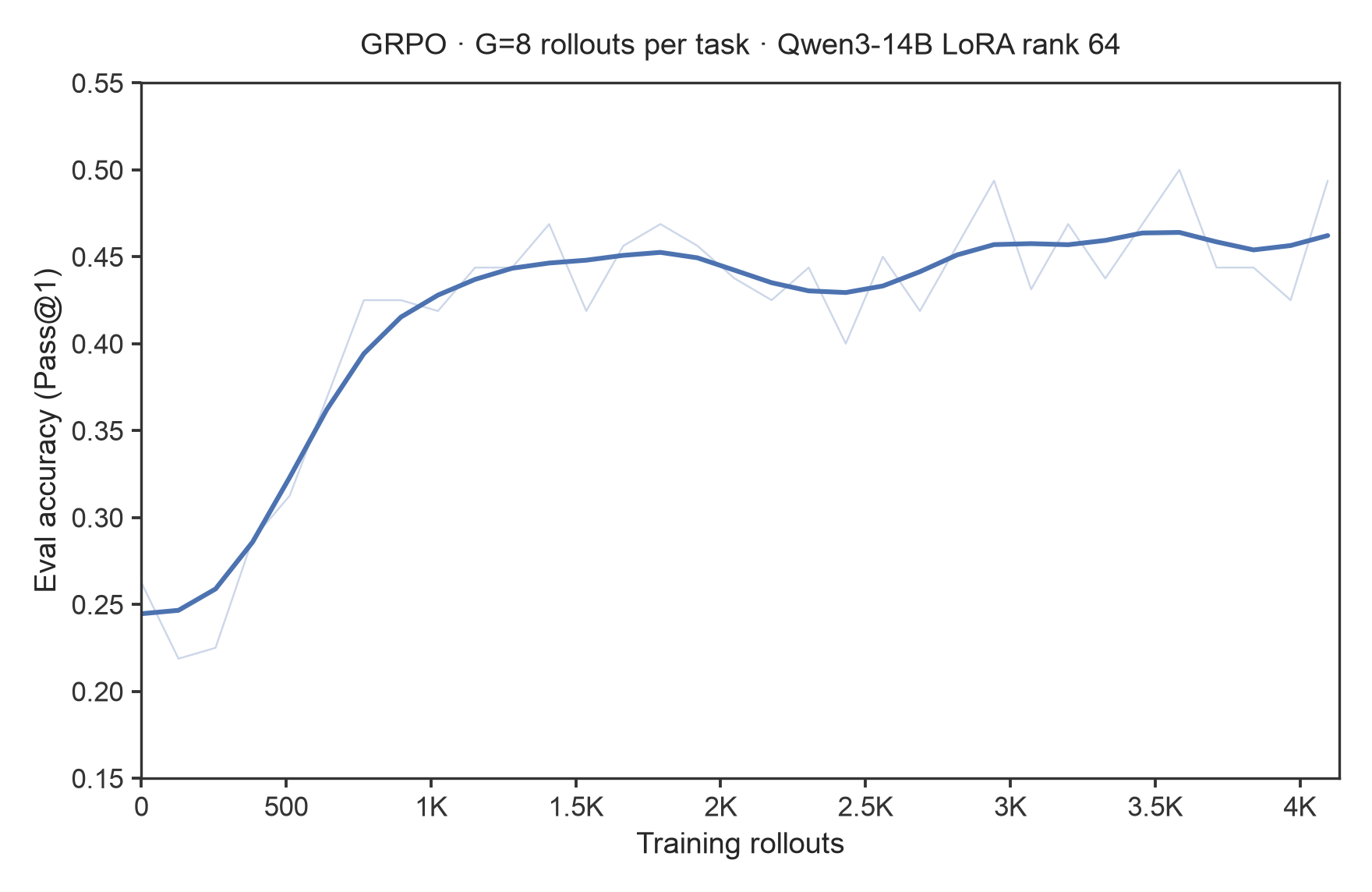
The run does two jobs for us. It shows the benchmark is learnable at all, so a flat line from any later method is a real result rather than a dead environment. And it sets the bar: eval-set Pass@1 climbs from the untrained model’s ~0.24 to a plateau around 0.45–0.46 over roughly 4K training rollouts. Every cheaper method in this report is measured against that plateau.
On-policy self-distillation
We started from GRPO because it works. But it only works under two conditions. It draws eight rollouts per task, and it draws them hot, at temperature 1.0, so the group spreads far enough apart to produce a gradient. A deployed agent gives you neither. It produces one trajectory per task, at the low temperature you actually ship at. That is the problem the bar leaves behind: how do you learn from a single trajectory and a paragraph of feedback, on rollouts sampled the way production samples them?
Text in place of the reward
The tool is on-policy self-distillation. Take the response the agent already produced, its own on-policy sample. Show the model that same response again, but this time with the feedback in its context, and watch how its own sense of the response shifts: which of its moves it now finds more likely, which mistake it now finds less. That shift is a target, and we distill it back into the model.
On-policy distillation On-Policy Distillation (Lu, 2025) trains a student on its own generated samples On-Policy Distillation of Language Models: Learning from Self-Generated Mistakes (Agarwal et al, 2023) rather than on text a teacher wrote. Self-distillation makes teacher and student one network, separated only by context Learning by Distilling Context (Snell et al, 2022): the teacher reads privileged information Learning Using Privileged Information: Similarity Control and Knowledge Transfer (Vapnik and Izmailov, 2015) that the student will not have at inference time. Zhao et al. Self-Distilled Reasoner: On-Policy Self-Distillation for Large Language Models (Zhao et al, 2026) take to be a verified reference solution; Hübotter et al. Reinforcement Learning via Self-Distillation (Hübotter et al, 2026) take it to be feedback written about a trajectory the agent has already produced, which is the setting here. Writing for the model and for the task,
The student samples a trajectory from its own policy and both distributions are evaluated at every token of it. The objective is the divergence between them, averaged along the trajectory and taken in expectation over tasks and over the student’s own rollouts:
That inner expectation is the on-policy part: the trajectories being scored are the ones the model actually produced, not ones written for it.
What remains is the choice of . Reverse KL puts the student in the first argument, so the sum over the vocabulary is weighted by the student’s own probabilities:
Forward KL is the same expression with the two arguments swapped, weighting by the teacher instead.
Our setup
We distil with reverse KL throughout; a later section puts it head to head against forward KL and generalized JSD. The teacher is the frozen base at , so the target holds still while the student trains. There is no reward term and no KL anchor to the reference policy.
The divergence is taken over the full next-token distribution at every position, not just over the probability the two models assign to the token the agent actually emitted. Zhao et al. ablate full-vocabulary logit distillation against the sampled-token alternative, which uses only the teacher’s log-probabilities at the tokens the student emitted, and report the full-vocabulary version stronger, at the cost of holding vocabulary-sized logits at every position. Hübotter et al. show that a top- approximation at captures most of that information at virtually no memory overhead, and that is what we use: the student’s top 100 tokens plus a single atom holding the remaining mass.
Illustration
The case for G = 1
Rollout count is the first of the two constraints. GRPO draws eight scored samples per task. We cut that to four, then to one for OPSD, and ask whether the run still learns.
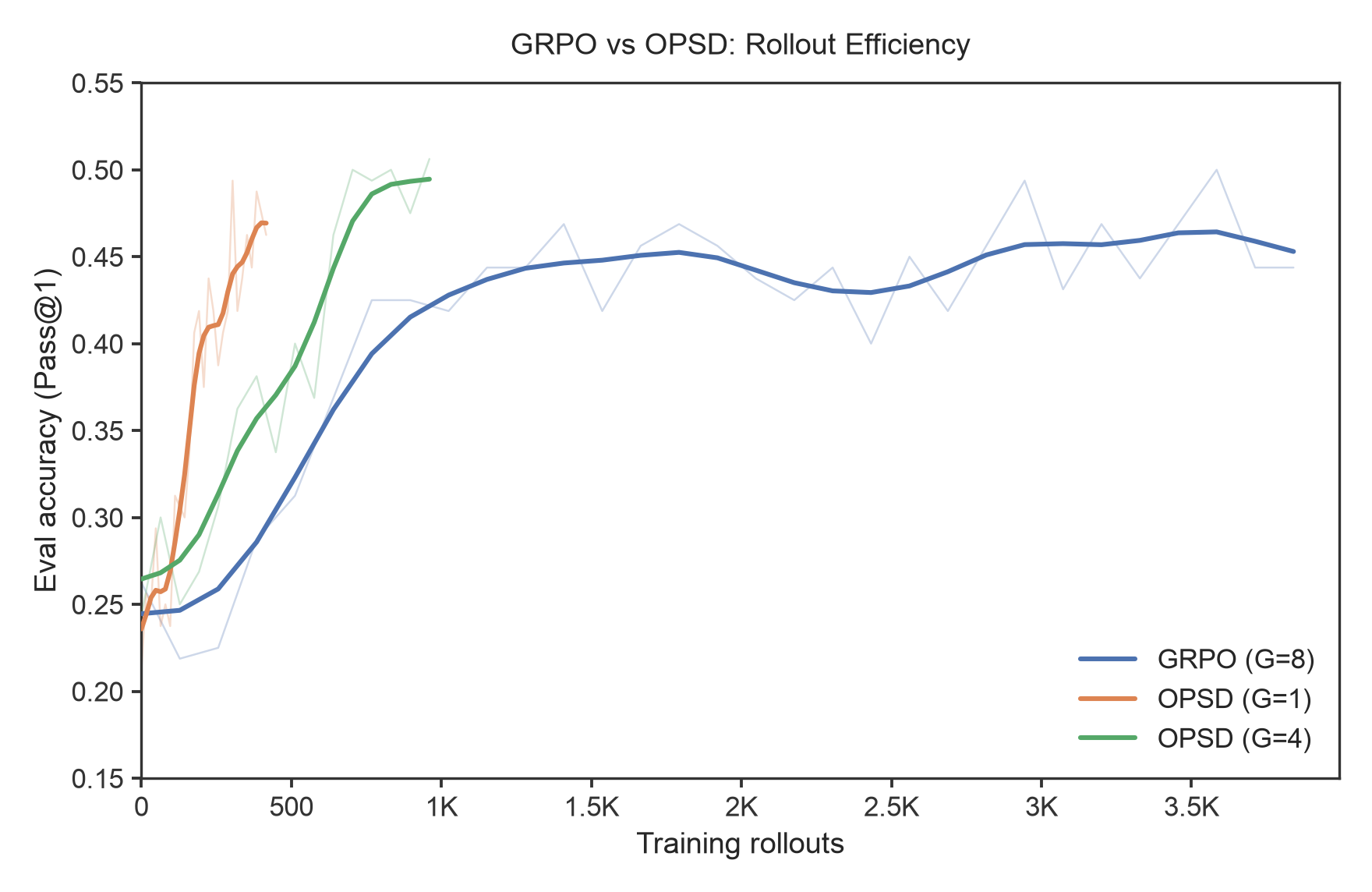
As we can see in the graph, both OPSD runs reach the GRPO bar with no reward in the objective. The one that matters for production logs is G = 1: a single trajectory per task, matching GRPO’s best eval-set accuracy at roughly a tenth of its rollouts.
The temperature you’d actually deploy at
The comparison above rolled out at temperature 1.0 to keep OPSD and GRPO on the same footing. However, no one rolls out at this temperature. A deployed tool-calling agent samples at much lower temperatures, because you want reliable actions rather than creative ones. Reward-RL learns from traffic it will never see.
GRPO generally needs hot rollouts because it requires a correct rollout to be present in the group. Self-distillation should not: its target is a per-token shift on the trajectory it already has, so it should be able to learn even when there is no positive rollout, as long as the feedback is present and of high quality. To test this hypothesis, we roll out at 0.6 and 0.3, everything else fixed.
| Rollout temperature | Pass@1 | Std. dev. |
|---|---|---|
| Base model, untrained | 0.23 | ± 0.02 |
| 1.0 | 0.46 | ± 0.03 |
| 0.6 | 0.48 | ± 0.02 |
| 0.3 | 0.45 | ± 0.03 |
The peaks are flat across all three temperatures with heavily overlapping error bars, so cooling the rollouts to the range you would actually deploy at costs nothing in eval-set Pass@1.
The design choices that matter
Put the last two sections together and we have a recipe that can learn from production logs: data with no reward beyond a failure flag, and no environment behind it, sampled at the low temperatures agents are actually deployed at, one rollout per task. From here we go into how to implement it: the practical questions that come up once you point this at real traffic, taken one at a time, with the ablations and analysis behind each answer.
Where do you put the feedback?
Self-distillation has been developed largely on single-answer reasoning problems: mathematical reasoning for Zhao et al., scientific reasoning and competitive programming for Hübotter et al. One prompt, one completion, one graded answer. In that setting placement isn’t a decision at all: there’s exactly one prompt, so the privileged signal goes in a block at the top of it and the whole completion sits downstream of it.
A multi-turn tool-calling agent is where the question becomes real: where in the context does the feedback go? A τ²-bench trajectory is a dozen-odd turns of tool calls, observations and user replies, with several distinct mistakes scattered through it, and inheriting the single-answer shape means one block at the top has to carry all of them at once.
The alternative comes out of industry. Cursor trains Composer 2.5 with what they call targeted textual feedback: Introducing Composer 2.5 (Cursor, 2026), and How On-Policy Self-Distillation Works (Sasha Rush, 2026) for a longer walkthrough. rather than leave a terminal reward to say where a long rollout went wrong, they insert a hint “directly at the point in the trajectory where the model could have behaved better” and add a distillation KL loss against the hint-conditioned teacher, alongside the broader RL objective. Their motivation is the one that brought us here: “credit assignment during RL is becoming an increasingly difficult challenge as rollouts can span hundreds of thousands of tokens.”
Top-level feedback. Let the trajectory run over turns , of which the reviewer flags a subset of size and writes feedback on each. The pieces are concatenated into one block appended to the task description at the top of the prompt,
and the divergence is taken across the whole trajectory that follows, under the rollout’s own loss mask , which is 1 on tokens the agent generated and 0 on tool outputs and user replies:
Every turn contributes, flagged or not, and every scored token is conditioned on all corrections rather than on the one written about its own turn.
Per-turn feedback. Each flagged turn becomes its own training example, so a rollout with of them yields rows rather than one. For turn the scored tokens are , the agent’s output at that turn alone. The student reads the true causal history ; the teacher reads the same history with attached, and nothing about the other turns:
No mask appears because is a single agent turn, so every token in it is scored.
Otherwise the two arms are the same run twice: same reviewer, same feedback, one config field apart.
| Placement | Pass@1 | Std. dev. |
|---|---|---|
| Base model, untrained | 0.23 | ± 0.02 |
| Per-turn | 0.48 | ± 0.02 |
| Top-level | 0.03 | ± 0.01 |
Per-turn climbs from the untrained model’s 0.23 to 0.48 and holds it. Top-level never gets above the untrained model at any point in the run: it drops below base on the first update and decays monotonically to 0.01. The rest of this section investigates the root causes of that collapse The Many Faces of On-Policy Distillation: Pitfalls, Mechanisms, and Fixes (Zhu et al, 2026) from several angles.
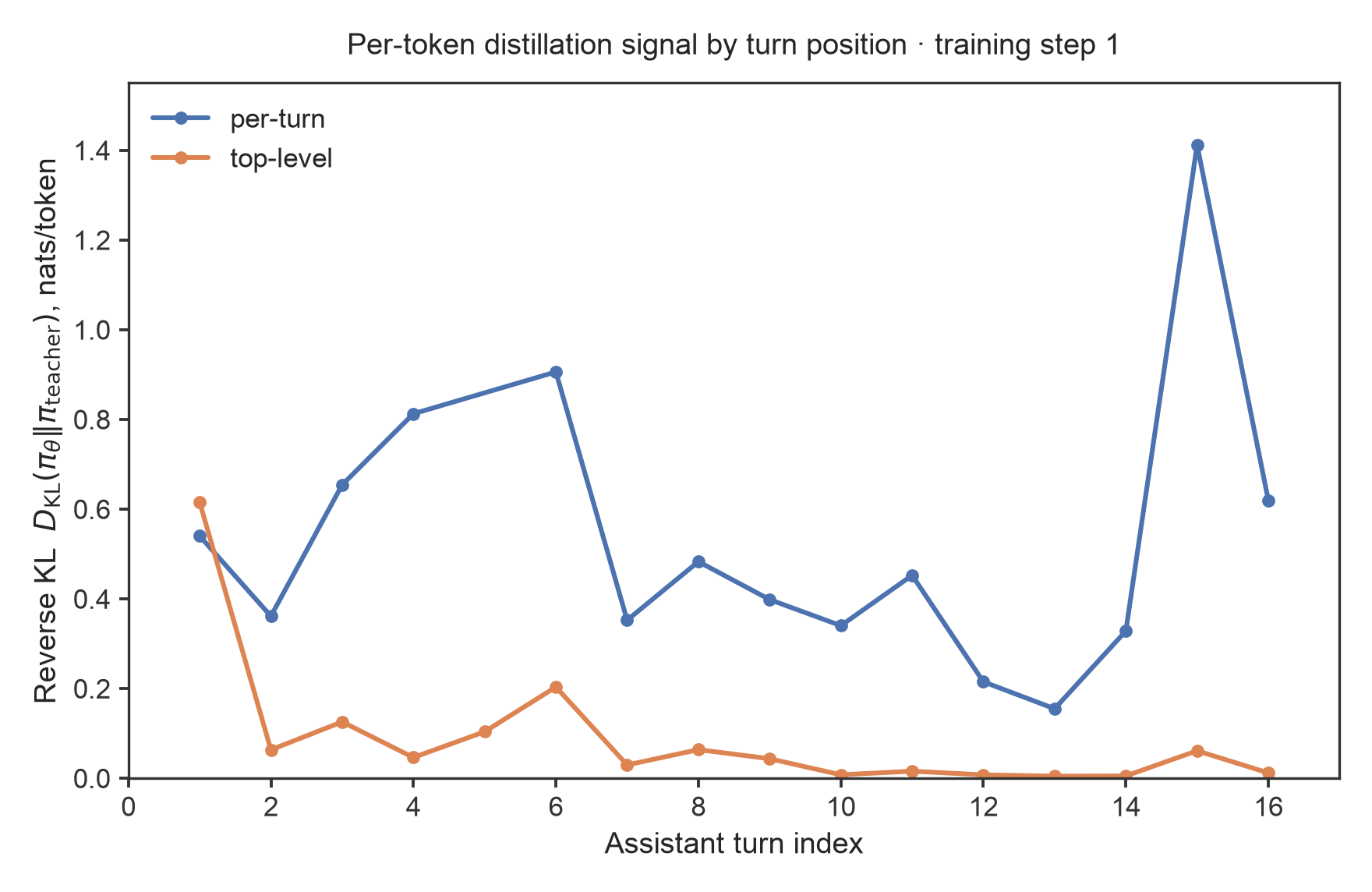
The feedback never reaches past the front of the episode. We started with the loss term itself. For every assistant turn we measured, token by token, how much the feedback-conditioned teacher disagrees with the student (that disagreement is the training signal), and plotted it against the turn’s position in the episode.
We find that at turn 1, right after the injected block, the two placements carry a comparable per-token signal. Top-level then falls away within a turn and sits near zero for the rest of the episode, while per-turn holds its level at every position with no positional trend. The appendix shows this token by token on a single turn scored under both placements.
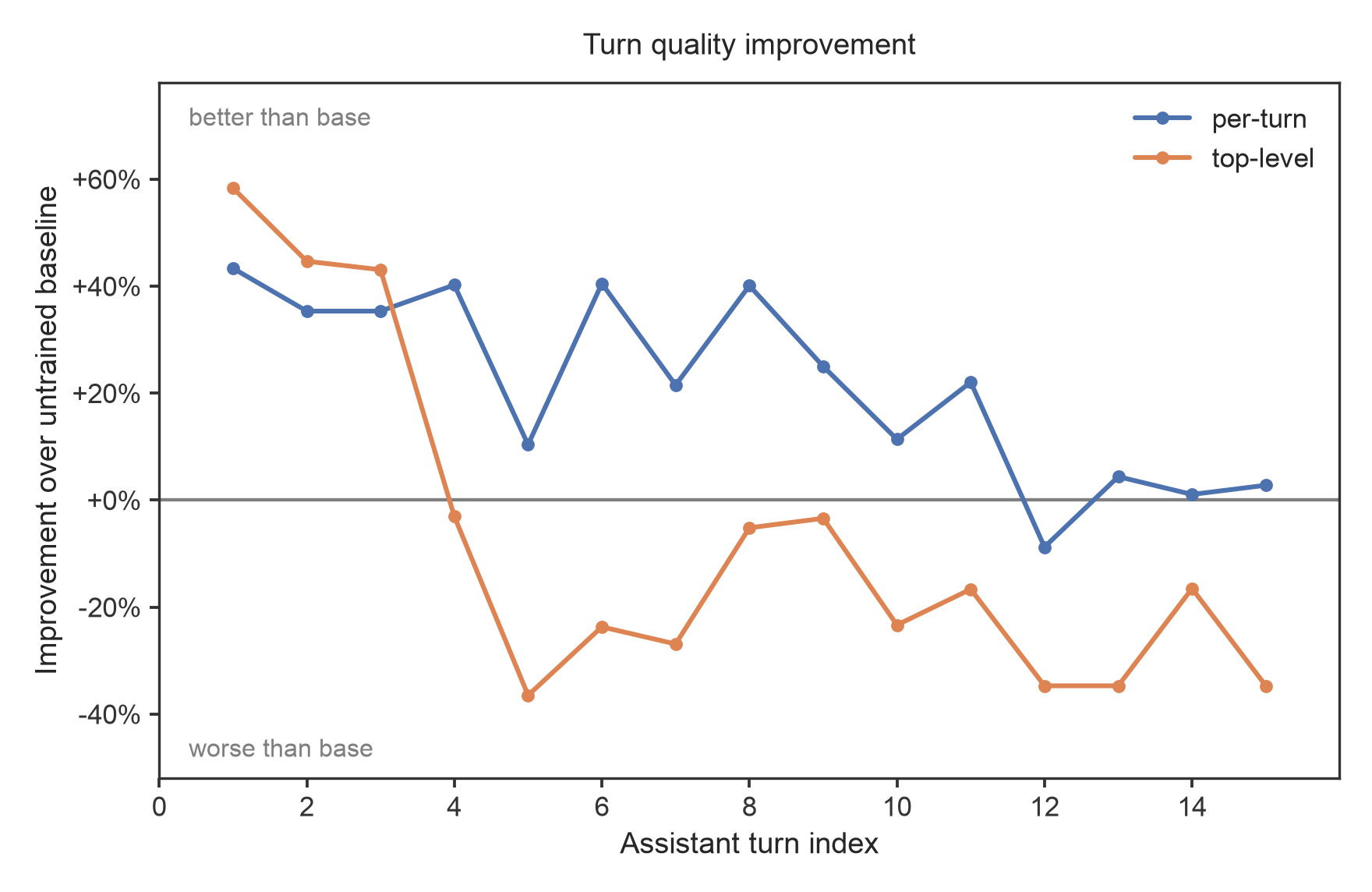
Signal that doesn’t arrive doesn’t leave the turn alone; it makes it worse. We then measured behaviour by turn position rather than in aggregate. We ran the reviewer over each trained policy’s own rollouts, asked at every position how often it marks that turn wrong, and differenced it against the untrained model, so the comparator is a flat line at zero.
Where the signal reaches, top-level works. Through the opening turns it is flagged far less often than the untrained model, by a wider margin than per-turn: it has essentially perfected the prologue of greet, authenticate, first lookup. Past the reach of its one injected block it crosses zero and spends the rest of the episode worse than the model that was never trained at all. Per-turn sits above zero at essentially every position.
We expected the unreached turns to come out neutral. Falling below zero means the objective degrades them rather than leaving them alone. One hypothesis is the coupling in top-level’s definition: it distils over the whole trajectory, including the turns the reviewer marked correct, and every turn is conditioned on the full aggregated block, most of which is unrelated to it.
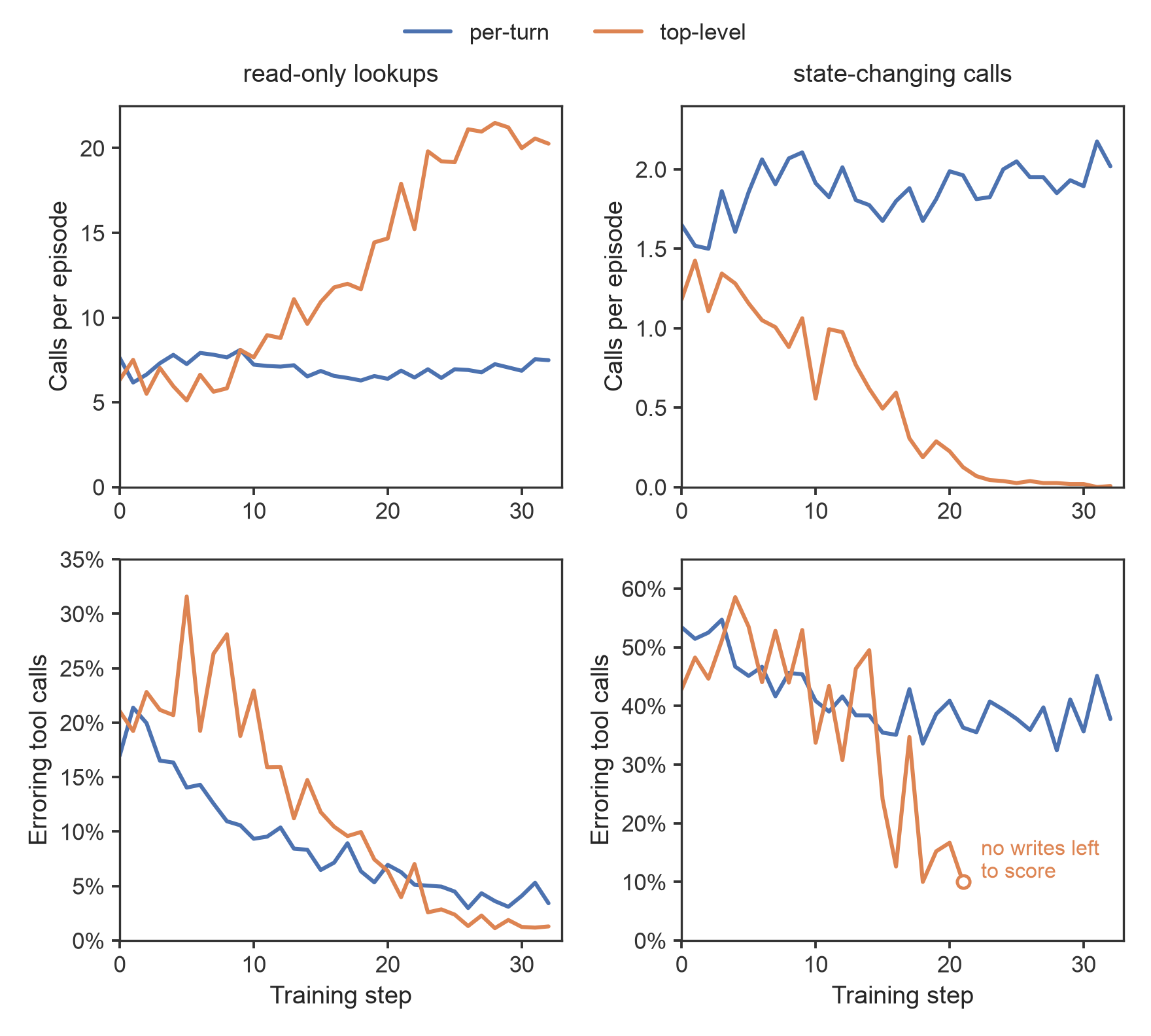
Where the collapse actually comes from. We then measured eval-set tool use over training, split two ways: read-only lookups against state-changing writes, and the volume of each against its error rate. The first outcome is that top-level does learn. Its read-call error rate falls steeply over training, further than per-turn’s, and its read volume triples.
The second outcome is the collapse. Over the same steps its write calls, generally made at the later turns in a rollout, fall to nearly zero. Keep Policy Gradient in Charge: Sibling-Guided Credit Distillation for Long-Horizon Tool-Use Agents (Ding et al, 2026). They report the same failure under naive self-distillation on τ³-airline. τ²-retail scores an episode on the conjunction of two checks, whether the database ended in the expected state and whether the agent told the user what the task required, and only writes can satisfy the first.
What kind of feedback do we use?
Placement settles where the signal goes; the other half of the question is what goes in that slot. In production, feedback ranges from what is already sitting in the trajectory up to the actual answer, which you would have to pay an expert for. Two rungs matter, each a different bet on how much to spend turning a raw log into a training signal.
Reflection on raw feedback. The cheap rung is written from what is already in the transcript: the tool errors the agent hit and the user’s own text, corrections, complaints, “no, I meant the other account.” Rather than pass that raw text through, a reviewer reads the trajectory HERO: Hindsight-Enhanced Reflection from Environment Observations for Agentic Self-Distillation (Liu et al, 2026) up to that point together with the tool error or user message that follows it, and answers a single question: given everything that had happened, why is this the moment that counts? Reflexion: Language Agents with Verbal Reinforcement Learning (Shinn et al, 2023) The reviewer has privileged information the agent never had in the moment: it can see the whole trajectory, including how things turned out, and it can relate what went wrong back to the domain policy the agent is graded against. It isn’t inventing new facts so much as rewriting the raw signal into words that carry more of its value, the same feedback, made legible. Our reflection methodology and feedback prompts are adopted from Liu et al., who introduce hindsight reflection as the privileged context.
Why is reflection needed? In knowledge work the rules live in a policy document, and a turn’s mistake is rarely self-contained, so the feedback for one turn is entangled with turns several steps earlier and cannot be isolated and passed through verbatim. In coding, a stack trace is already verbose and local enough to act as the signal on its own, and reflection may buy little there.
That reflection has to be written by something. A human could do it, but we want an automatic loop, so a model does. We use an off-the-shelf Gemini 3.1 Pro for this. Using a model keeps the step automatic enough to run over logged sessions in production, which is what makes this rung practical at scale. We believe that if the student model is big enough, the model itself can be used as the reviewer to generate the feedback.
Gold, if you’ll pay for it. At the top sits the actual answer. Spend the extra time and money on human graders and they’ll read a full trajectory and hand back the gold result: what the agent should have done. Worth being precise about what that means here: not a golden trajectory or a successful rollout to imitate, but the final actions that satisfy the task’s reward conditions, the reference tool calls, with their exact argument values, that leave the database in the state the grader checks for.
| Feedback (per-turn, G = 1) | Pass@1 | Std. dev. |
|---|---|---|
| Base model, untrained | 0.23 | ± 0.02 |
| Self-reflection | 0.48 | ± 0.02 |
| Gold (oracle) | 0.05 | ± 0.02 |
Gold collapses because it trains the agent to act and never ask. Conditioned on the exact tool calls that satisfy the reward, the teacher never has a reason to ask the user anything: at every turn its correction amounts to execute the next action now. The student learns the executable half of that and stops reasoning about what it doesn’t know yet: it quits asking the user for information and just fires tool calls at the database. The signature is how much of the conversation is still conversation: user-facing turns fall from the base model’s ~27% of assistant turns to ~15% over twelve steps, while the reflection arm climbs to ~38%.
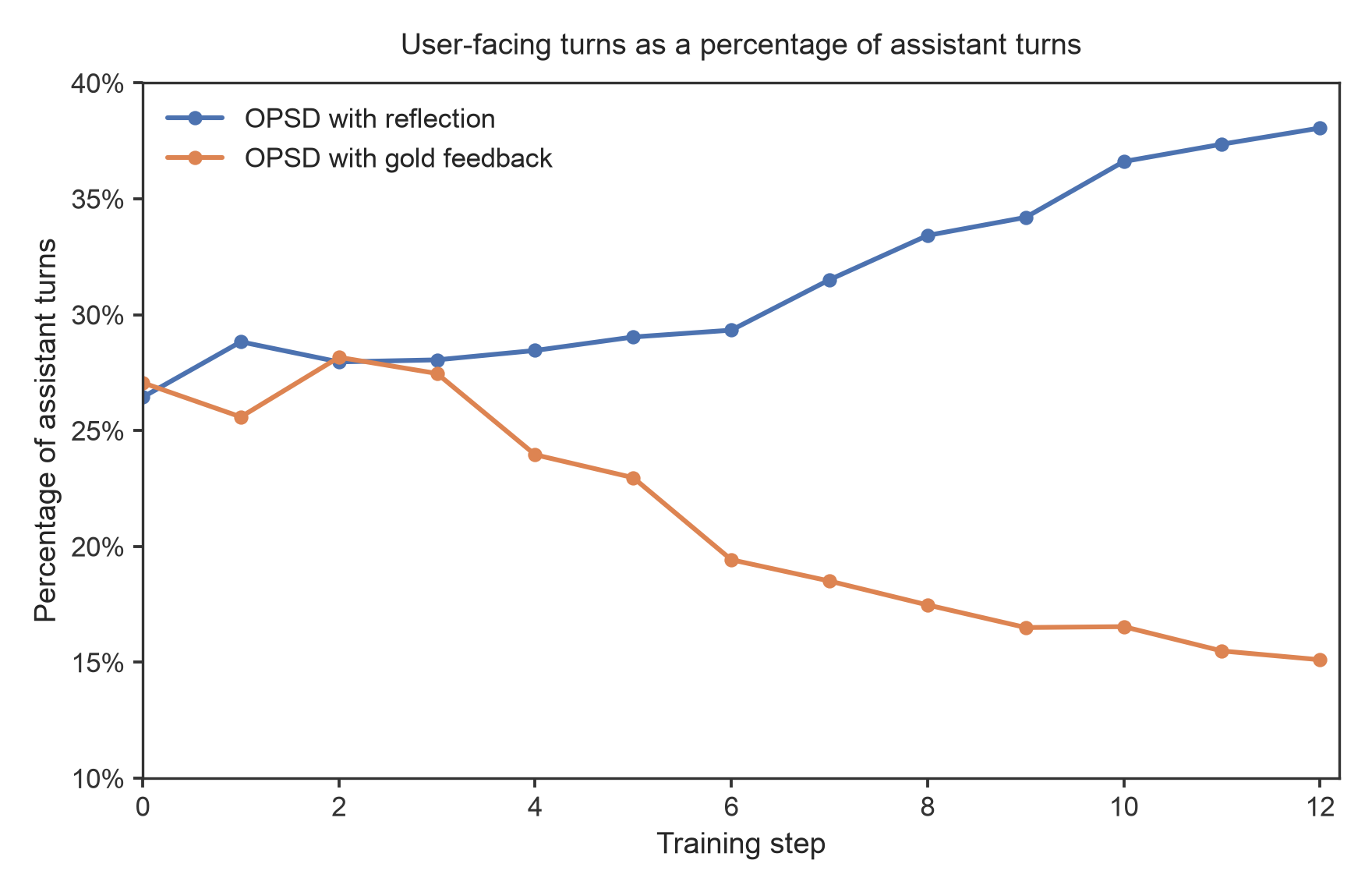
Figure 8 shows that happening at a single decision. The reference path for this task is two exchange_delivered_order_items calls and nothing else, so at turn 1 the gold teacher demands the exchange, the final action of the task, before the user has been identified at all. The reflection teacher at the same position has no answer sheet, leaves the agent’s lookup alone, and rejects opening with a tool call at all, putting its mass on the first word of a question back to the user.
Which objective do you distill with?
What the feedback says and where it sits settle what the model sees; the loss settles in which direction it gets pulled toward the feedback-shifted distribution. That is the usual mode-covering-versus-mode-seeking tradeoff, MiniLLM: On-Policy Distillation of Large Language Models (Gu et al, 2023) and it bites differently on agentic rollouts. Three choices.
Forward KL, mode covering. The teacher weights the sum over the vocabulary, so the student is pushed to reproduce the whole feedback-conditioned distribution, tails included.
Reverse KL, mode seeking. The student weights the sum, so it concentrates on the subset of corrected behaviours it already places mass on rather than spreading across all of them.
Generalized Jensen–Shannon, the symmetric middle. Both distributions are measured against a mixture of the two, with dialling between them. Writing ,
with recovering forward KL and reverse KL. See Agarwal et al. for the generalized JSD family this interpolation comes from.
| Divergence | Pass@1 | Std. dev. |
|---|---|---|
| Base model, untrained | 0.23 | ± 0.02 |
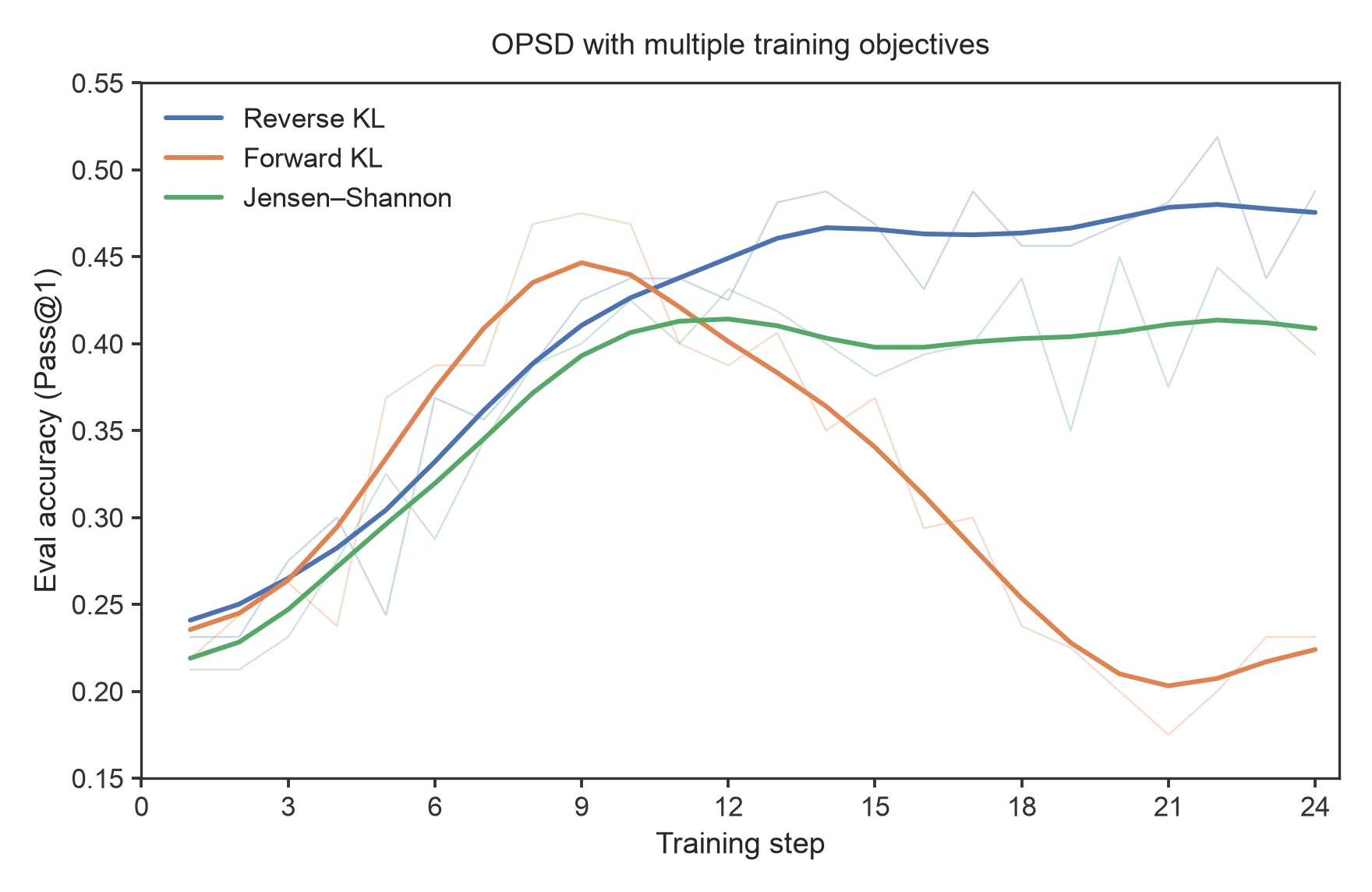
| Reverse KL (α = 1) | 0.48 | ± 0.02 |
| Forward KL (α = 0) | 0.45 | ± 0.02 |
| Jensen–Shannon (α = 0.5) | 0.41 | ± 0.03 |
Reverse KL reaches the highest peak and holds it. Forward KL is close on the peak alone, but it crests early and then decays below the untrained model, so the peak understates the gap. Jensen–Shannon settles between the two and stays flat.
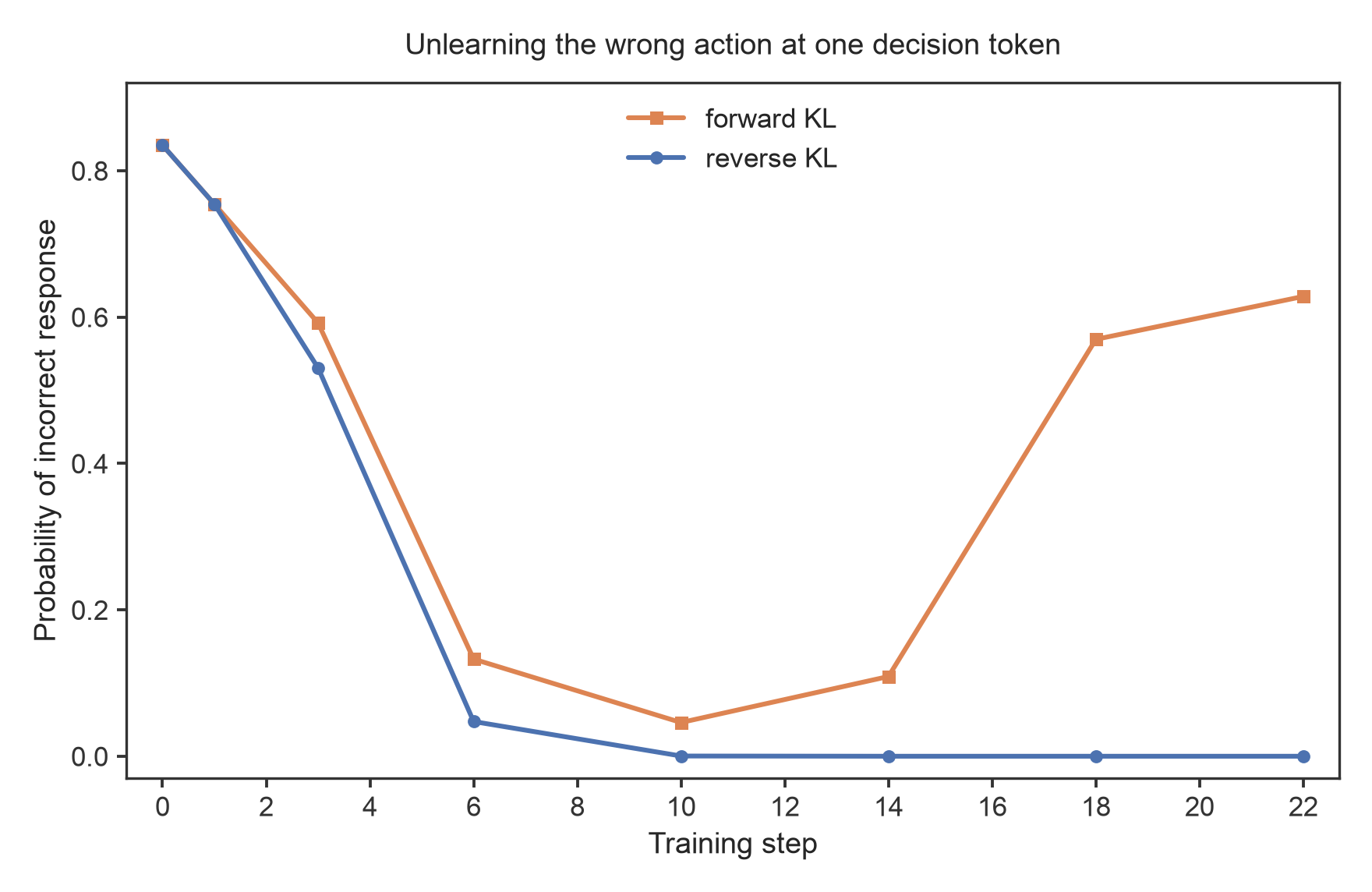
Forward KL prices the deciding token at almost nothing. We took one scored turn where the next token chooses between opening a tool call and asking the user, and computed each objective’s exact per-token divergence at that position. The right answer there is the user-facing token, not a tool call: two fabricated authentication lookups have already failed, so the teacher puts almost all its mass on asking and almost none on acting again. Reverse KL is zero-forcing: its terms carry the log-ratio , which blows up wherever the student holds mass the teacher rules out, and deleting a wrong action is exactly that case. Forward KL is zero-avoiding instead. It is unbounded when the student misses teacher mass, but the term for mass the teacher doesn’t want is scaled by the teacher’s own probability, which here is near zero.
I and 2.7e-5 on <tool_call>. Rows are the exact per-token divergence, log-shaded. Forward KL's one large term lands on transfer, a token reached only if the decision already went wrong.So the two objectives can both be satisfied, by different routes, and probing the same decision on every checkpoint shows which route each one takes. Probabilities sum to one, so raising the probability of asking the user to the teacher’s 0.962 mechanically squeezes the tool call down to about 0.04. Forward KL bottoms out at 0.046 and goes no further: that is the floor mode-covering implies, reached as a side effect rather than as a correction, and it has almost no pressure left to close the remaining three orders of magnitude. Nothing holds the branch down either, and by step 22 it is back above 0.6. Reverse KL drives the same branch to zero within a few steps and it stays there.
Continual learning without forgetting
One of the quiet reasons to train on-policy at all is that it tends not to wreck what the model already knew. Off-policy SFT drags the model onto a distribution that isn’t its own and can overwrite unrelated skills, the classic catastrophic-forgetting Retaining by Doing: The Role of On-Policy Data in Mitigating Forgetting (Chen et al, 2025) failure, whereas on-policy methods keep training on the model’s own samples, which is far gentler RL’s Razor: Why Online Reinforcement Learning Forgets Less (Shenfeld et al, 2025) on everything you weren’t trying to change.
We set the test up as two sequential phases. In phase 1 we train OPSD on τ²-bench retail. In phase 2 we take that checkpoint, optimizer state and all, and continue training on telecom alone, while still evaluating retail at every step. The two domains are far apart: different tools, different rules, and none of telecom’s appear anywhere in retail. Telecom also has tools the agent cannot call at all, because they belong to the user’s own device, so it has to walk the user through operating them, a mode retail never exercises.
If distillation were quietly overwriting what the model knew, retail is where it would show: it receives no gradient at all through phase 2 while telecom training pushes the weights around. If on-policy training is doing its job retail should hold, and to the extent the skill OPSD sharpens is domain-general, it may even tick up.
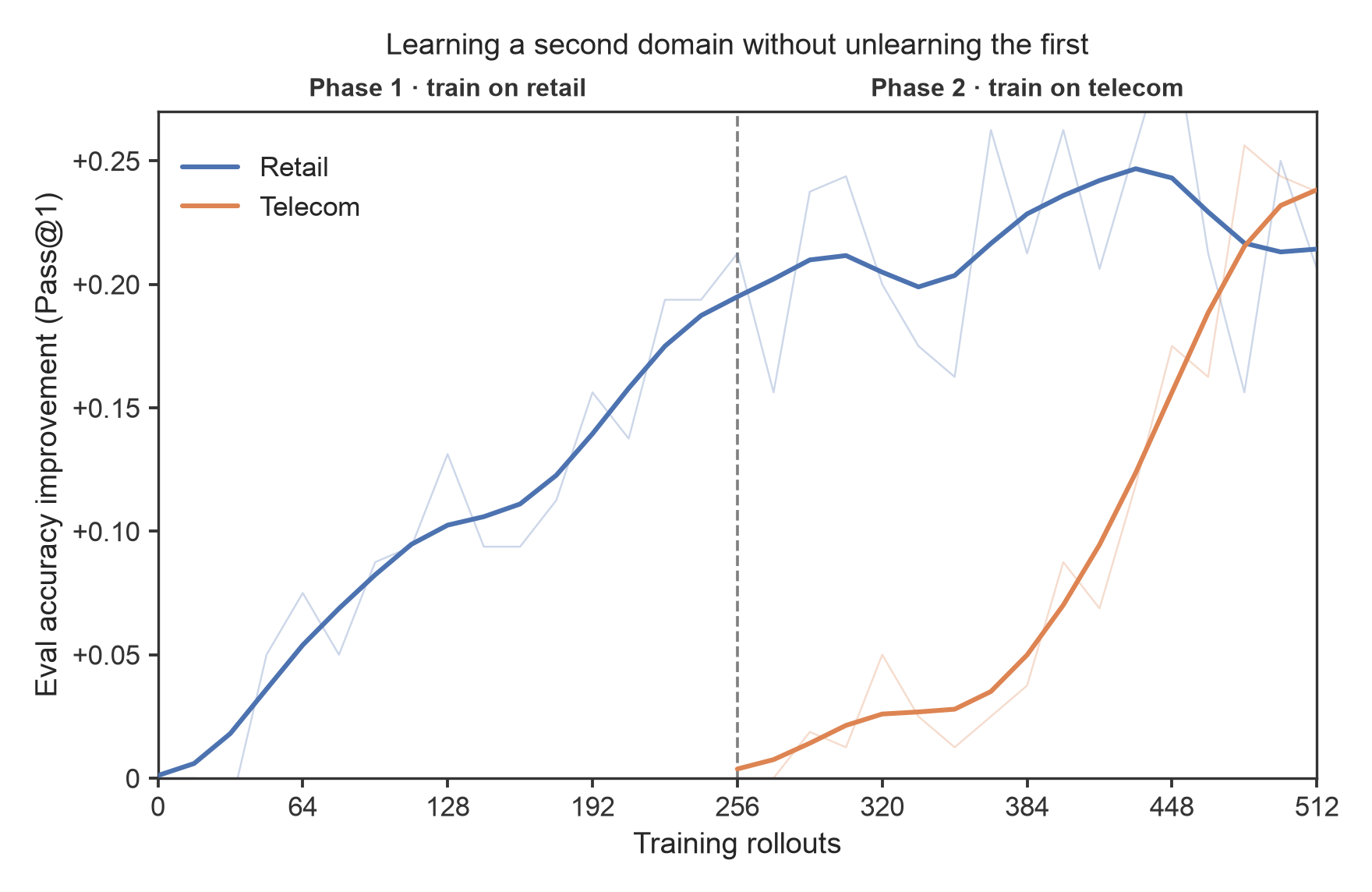
Retail does not budge. It holds its phase-1 gain through all of phase 2, flat and pointedly not decaying, while telecom picks up a gain of its own of about the same size from a far lower base. Telecom here is trained, not unseen, so this is evidence about forgetting rather than zero-shot transfer, and on that question the answer is clean: sequential specialization accumulates Self-Distillation Enables Continual Learning (Shenfeld et al, 2026) instead of trading off.
Conclusion
The feedback a deployed agent already receives is enough to train it. One trajectory per task, sampled at the temperature you actually ship at, with a reviewer’s reflection placed at the turn it is about and distilled under reverse KL, matches the GRPO baseline’s best Pass@1 at roughly a tenth of the rollouts. Those gains stack across domains rather than trading against each other.
The open work item is the on-policy assumption itself. Every result here scores trajectories the current policy has just produced, but production does not arrive one rollout at a time in step with your gradient updates. It arrives in bulk, and you cannot deploy a checkpoint per gradient step, so by the time a batch is trained on it was sampled from a policy several updates old. Which makes the next question a quantitative one: how off-policy can you go before the teacher’s shift stops correcting the model’s own distribution?
Citation
Please cite this work as:
Goyal, Kartik, "On-Policy Self-Distillation: Continual Learning from Production Feedback",
Kartik Goyal: Research, Aug 2026.
Or use the BibTeX citation:
@article{goyal2026onpolicyselfdistillation,
  author = {Kartik Goyal},
  title = {On-Policy Self-Distillation: Continual Learning from Production Feedback},
  journal = {Kartik Goyal: Research},
  year = {2026},
  note = {https://kartikgoyal.ai/research/on-policy-self-distillation},
  doi = {10.5281/zenodo.21830862},
}
Appendix
The same turn, scored under two placements
Each row below is a single turn from one τ²-bench retail rollout, and the two columns score the identical token sequence, the model’s own output at that turn, against a teacher that read the same reviewer feedback. The only thing that differs is where that feedback sits in the teacher’s context: immediately before the turn on the left, and aggregated into the first user message on the right. Shading is the exact full-vocabulary reverse KL between student and teacher at each token, which is the OPSD loss term itself, so a darker token is one the feedback moved and a pale one is a token the teacher had nothing to say about.
Reading down the rows, the left column stays dark at every position while the right column fades to almost nothing past the opening turns. That is the reach failure from Figure 4 seen one token at a time.